
Artificial Intelligence is slowly but surely making its way from an IT novelty for top-level coders to experiment with and transnational corporations to try out, into an everyday tool used by anyone and everyone. AI-generated videos are all over YouTube, texts created by ChatGPT, and images generated by Midjourney, DALL·E 3, and Firefly flood the internet. People are becoming accustomed to the convenience and speed that AI-powered tools offer. Many even replaced Google searches with ChatGPT requests.
Seems like AI has already become a new normal, and in the near future, there’s going to be nothing that will disrupt the existing AI landscape. In reality, this couldn’t be further from the truth, as generative AI we all know and love is getting overshadowed by the next big thing — AI agents.
In this article, we’ll dive deep into what AI agents are, why they are talked about so much, what benefits they bring modern businesses, and whether or not entrepreneurs should tap into AI agents' development today.
What Are AI Agents and How They Work
The term “AI Agent” refers to a digital system designed to autonomously perceive its environment, make decisions, and act upon them to achieve a specific goal set by a human.
The primary difference between AI agents and traditional software scripts or deterministic bots lies in the agent’s ability to dynamically analyze the environment, interact with it, adapt, and evolve.
Key components of an AI agent
- A perception layer is designed to gather data from the environment (e.g., user inputs, sensors, APIs), process it, and structure it accordingly. The goal is to make different types of data usable, filter out the noise, anomalies, and irrelevant information to get a clean base for accurate decision-making.
- A decision-making engine uses rule-based logic, ML algorithms, or reinforcement learning to decide the next action. Oftentimes, it involves task decomposition, breaking a larger problem into smaller, manageable tasks and mapping out the series of actions that can be taken to achieve the set goal.
- An actuator layer executes tasks via APIs, UI interactions, or message passing. This is where AI agents can augment their abilities by incorporating external tools and interact with the environment dynamically.
- A feedback loop helps an AI agent to learn from achieved results, optimize future actions, and improve when needed. This ability to become better is attained through supervised, unsupervised, and reinforcement learning.
As a result, an AI agent is capable of receiving a task, calculating the optimal way to implement it, carrying out the necessary actions for task completion, and adjusting the action plan if something does not go as planned. The best part about it? AI agents can perform all of this with minimal/no human supervision. Such autonomy makes them extremely valuable for all kinds of businesses, especially those with structured workflows and numerous low-effort routine tasks.
The Difference Between Generative AI and AI Agents
At first glance, AI agents may seem like just another iteration of generative AI. After all, both rely on machine learning models, natural language processing, and large amounts of data to function. However, despite the shared technological foundation, generative AI and AI agents serve very different purposes.
Generative AI is primarily reactive. It waits for a prompt, generates a response, and stops there. A user asks ChatGPT to write an email, Midjourney to create an image, or Claude to summarize a document, and the system delivers the requested output. The interaction is usually isolated, short-lived, and heavily dependent on human guidance.
AI agents, on the other hand, are proactive and goal-oriented. Instead of merely generating content or responding to prompts, they can independently plan, execute, monitor, and adjust actions to achieve a broader objective. They are not limited to a single interaction. AI agents can maintain context across multiple steps, use external tools, retrieve additional information, communicate with other systems, and even collaborate with other agents.
In simple terms, generative AI answers questions, while AI agents perform tasks.
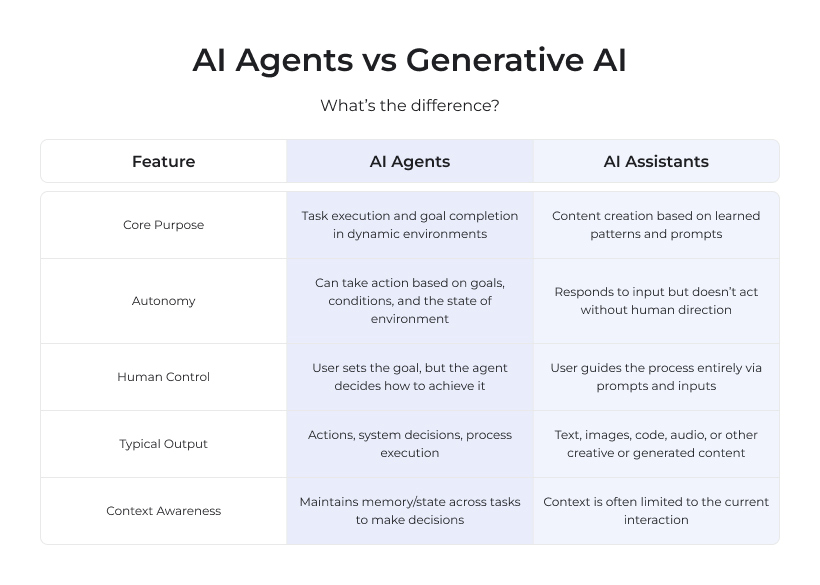
For example, a generative AI model can draft an email for a sales manager. An AI agent, however, can analyze CRM data, identify high-priority leads, personalize outreach messages, send emails, monitor replies, schedule meetings, and update the CRM automatically — all with minimal human intervention.
Another important distinction lies in memory and adaptability. Traditional generative AI tools are often stateless, meaning they treat each interaction independently unless memory features are specifically added. AI agents are designed to maintain awareness of past actions, evaluate outcomes, and refine future behavior accordingly.
This shift from “content generation” to “autonomous execution” is precisely why AI agents are gaining so much attention across industries. Businesses are no longer interested in AI merely producing outputs. They want AI to actively participate in workflows, optimize operations, and reduce the need for repetitive human involvement.
Why AI Agents Are Becoming So Popular
The rapid rise of AI agents is not happening by accident. Several technological and business-related factors have aligned at the same time, creating ideal conditions for widespread adoption.
First and foremost, modern AI models have become significantly more capable. Large Language Models (LLMs) like GPT-4, Claude, Gemini, and open-source alternatives can now reason, summarize, classify, plan, and interpret information with impressive accuracy. These models provide the cognitive foundation AI agents need to operate autonomously.
At the same time, businesses are under increasing pressure to optimize operations without endlessly scaling headcount. Rising operational costs, labor shortages in certain sectors, and growing customer expectations force organizations to search for new ways to improve efficiency. AI agents offer an attractive solution because they can automate not just isolated tasks, but entire workflows.
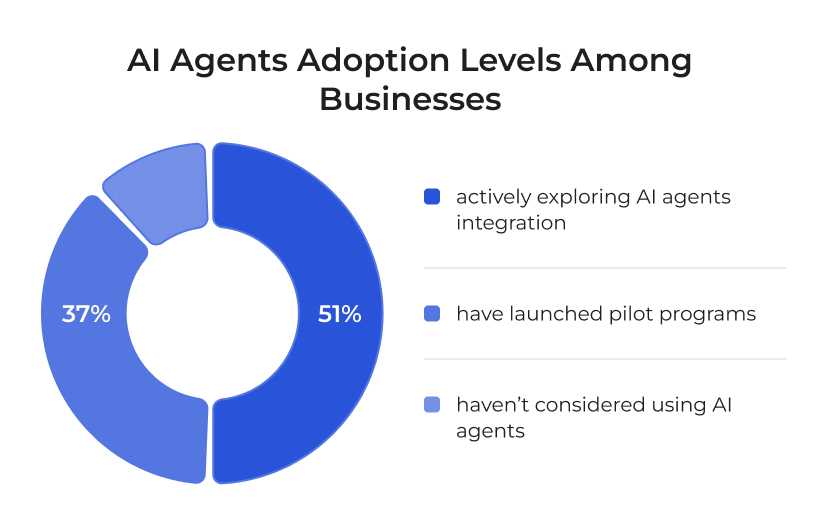
Another major driver behind AI agent adoption is the growing maturity of API ecosystems. Modern software products are highly interconnected through APIs, allowing AI agents to interact with CRMs, ERPs, communication platforms, analytics systems, cloud infrastructure, and countless third-party tools.
This connectivity dramatically expands what AI agents can actually do in real-world business environments. Instead of remaining trapped inside a chatbot interface, agents can actively interact with business systems and execute meaningful operational tasks.
Additionally, businesses are beginning to realize that traditional automation has limitations. Rule-based automation works well for predictable workflows but struggles whenever ambiguity, exceptions, or unstructured data are involved. AI agents fill this gap by combining automation with contextual reasoning and adaptability.
For example:
- Traditional automation can route invoices based on predefined conditions.
- An AI agent can analyze invoice content, detect anomalies, communicate with vendors, request missing information, escalate suspicious transactions, and continuously improve the process over time.
The rise of multimodal AI also contributes to the growing popularity of AI agents. Modern systems can process not only text but also images, audio, video, and structured datasets simultaneously. This enables AI agents to operate in increasingly complex environments that resemble real-world business operations more closely.
Finally, there is a psychological factor. Businesses have already become comfortable with generative AI tools through widespread public exposure. Teams use ChatGPT for drafting content, developers rely on GitHub Copilot, and marketers experiment with AI-generated visuals daily. As familiarity grows, companies become more open to integrating more advanced forms of AI into operational processes. In many ways, AI agents represent the natural next step in the evolution of enterprise AI adoption.
Types of AI Agents
AI agents are not a one-size-fits-all technology. Depending on the level of complexity, autonomy, and reasoning involved, different types of AI agents can be used for different business scenarios.
Reactive agents are the simplest form of AI agents. They operate based on current input without maintaining memory of previous interactions. These agents are effective for straightforward, fast-response environments where decisions depend solely on present conditions. Examples include basic customer support assistants or recommendation engines.
Model-based agents are more advanced because they maintain an internal representation of the environment. This allows them to make decisions based not only on current input but also on previous states and contextual information. Such agents are commonly used in logistics, operational monitoring, and inventory management.
Goal-based agents take things a step further. Instead of simply reacting to situations, they evaluate possible actions based on how effectively those actions contribute toward achieving a defined objective. This makes them highly valuable for business process optimization, scheduling systems, and strategic task execution.
Utility-based agents introduce another layer of sophistication by evaluating not just whether a goal can be achieved, but how beneficial each potential outcome is. These agents can weigh trade-offs such as speed, cost, efficiency, and risk to determine the optimal course of action.
Learning agents continuously improve their behavior through feedback and experience. Using machine learning and reinforcement learning techniques, these systems adapt to changing environments, optimize performance, and become increasingly efficient over time.
Finally, multi-agent systems involve multiple AI agents collaborating to solve complex tasks. Each agent may specialize in a specific function while communicating and coordinating with other agents. This approach is particularly useful in enterprise environments with interconnected workflows and large-scale operational ecosystems.
For example, in a supply chain environment, one agent may monitor inventory levels, another forecasts demand, another handles supplier communication, while another optimizes delivery routes. Together, these agents form an intelligent ecosystem capable of managing highly dynamic business operations.
How Businesses Are Using AI Agents Today
While AI agents may still sound futuristic to some, many businesses are already implementing them across various departments and operational processes.
Customer support is one of the most common adoption areas. AI agents can handle customer inquiries, retrieve account information, resolve routine issues, escalate complex cases, and maintain conversational continuity across multiple interactions. Unlike traditional chatbots, modern AI agents can understand context, adapt responses dynamically, and integrate with internal systems to complete tasks directly.
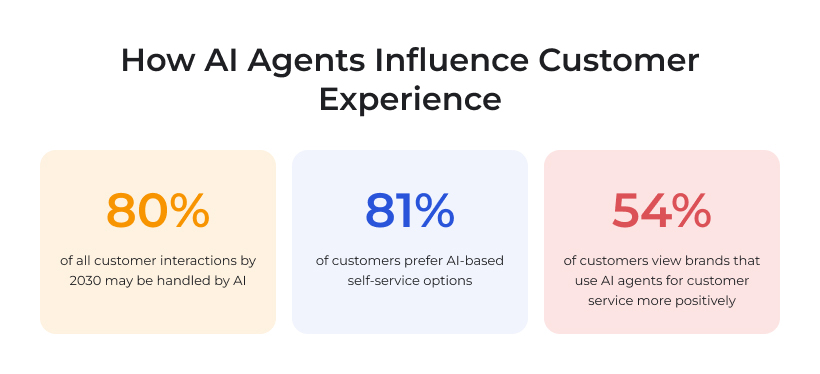
Sales and marketing teams increasingly use AI agents to automate lead qualification, personalize outreach campaigns, generate sales insights, and optimize customer engagement strategies. AI agents can analyze CRM data, identify high-conversion opportunities, monitor customer behavior, and even suggest the best timing for communication.
In HR departments, AI agents assist with candidate screening, interview scheduling, onboarding workflows, policy guidance, and employee support. Some organizations also use AI-powered internal assistants to help employees quickly access company knowledge and documentation.
Finance teams leverage AI agents for invoice processing, fraud detection, budgeting support, compliance monitoring, and financial forecasting. Since financial workflows often involve large volumes of structured and semi-structured data, AI agents can significantly reduce manual effort while improving accuracy.
Healthcare organizations are experimenting with AI agents for patient triage, appointment management, clinical documentation support, administrative automation, and medical data analysis. However, due to regulatory and ethical concerns, healthcare deployments often require stricter oversight and governance frameworks.
IT and DevOps teams use AI agents to monitor infrastructure, identify anomalies, automate incident response, optimize cloud resource allocation, and assist with cybersecurity operations. In some cases, AI agents can even generate code suggestions or troubleshoot technical issues autonomously.
In eCommerce, AI agents personalize shopping experiences, optimize inventory management, automate order processing, handle returns, and provide customer support at scale. Retailers increasingly view AI agents as a way to improve operational efficiency while maintaining personalized customer experiences.
Manufacturing and logistics companies are also embracing AI agents for predictive maintenance, route optimization, warehouse management, production planning, and supply chain coordination.
The key pattern across all these industries is simple: AI agents excel in environments that involve repetitive workflows, large amounts of data, dynamic decision-making, and operational complexity.
The Business Benefits of AI Agents
The growing interest in AI agents is driven not just by technological curiosity, but by very real business advantages.
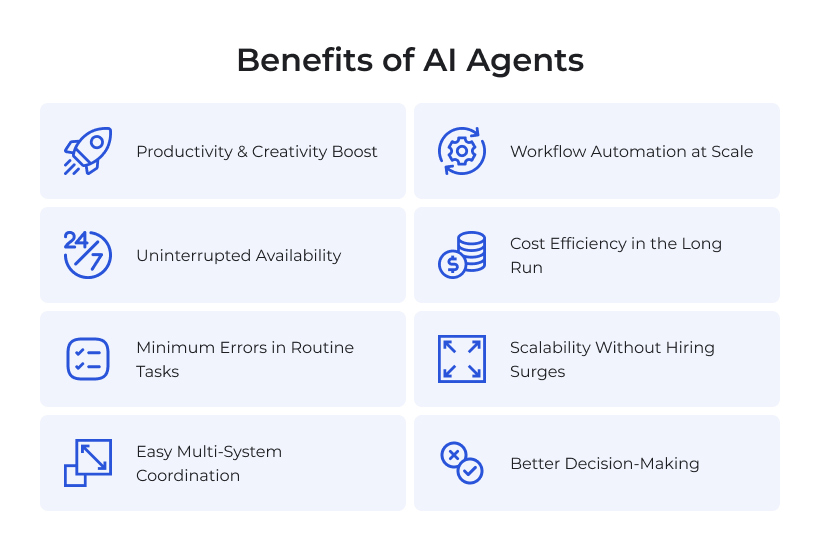
One of the most obvious benefits is operational efficiency. AI agents can perform repetitive tasks faster and more consistently than humans while operating 24/7 without fatigue. This allows businesses to reduce manual workload, accelerate processes, and improve overall productivity.
Cost optimization is another major advantage. By automating labor-intensive workflows, businesses can reduce operational expenses and allocate human employees toward higher-value strategic work instead of routine administrative tasks.
AI agents also improve scalability. Traditional operational growth often requires proportional hiring increases. AI agents allow organizations to handle growing workloads without expanding teams at the same rate.
Consistency and accuracy are equally important. Human employees naturally experience variability in performance, especially when dealing with repetitive tasks over long periods. AI agents maintain consistent execution standards and reduce the risk of human error.
Decision-making can also become faster and more data-driven. AI agents are capable of analyzing massive datasets in real time, identifying patterns, and generating actionable insights that would be difficult for humans to process manually.
AI agents can also enhance organizational agility. Because they adapt dynamically to changing conditions, businesses can respond to market shifts, operational disruptions, and evolving customer needs more effectively. Importantly,
AI agents do not necessarily replace employees. In many cases, they augment human capabilities by handling repetitive operational work, allowing teams to focus on creativity, strategy, relationship-building, and complex problem-solving. Companies that approach AI agents as collaborative productivity tools rather than pure workforce replacement mechanisms are often more successful in long-term adoption.
Challenges and Risks Businesses Must Consider
Despite their enormous potential, AI agents are not without risks and limitations. Businesses that rush into implementation without proper planning can encounter significant operational, technical, and ethical challenges.
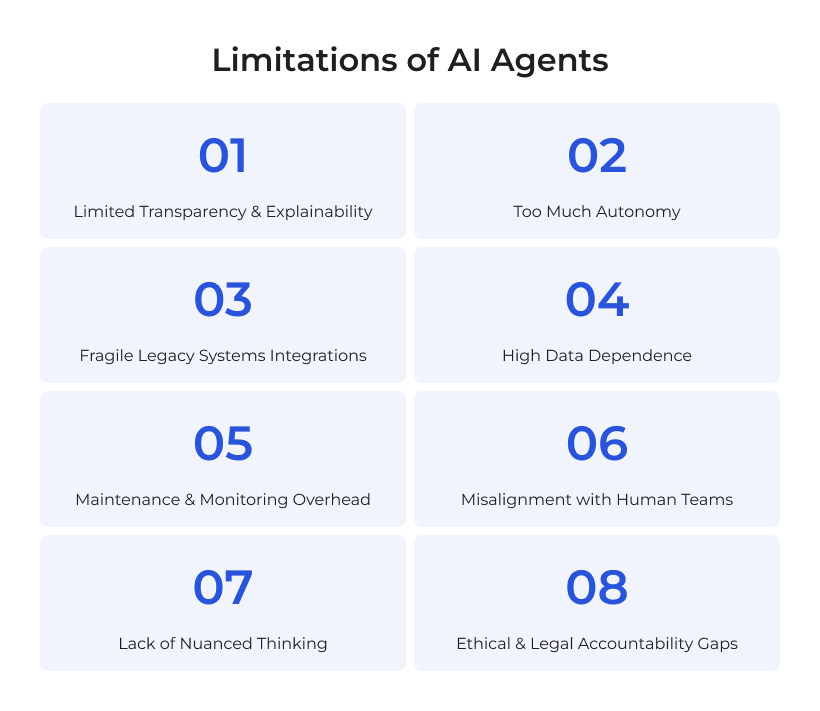
One major concern is reliability. AI agents can make mistakes, misunderstand context, or generate inaccurate outputs. When AI agents are integrated deeply into operational workflows, these errors can have real business consequences. Hallucinations remain a persistent challenge for LLM-powered systems. An AI agent may confidently provide incorrect information, misinterpret instructions, or perform unintended actions if guardrails are insufficient.
Security and data privacy are also critical considerations. AI agents often require access to sensitive company systems, customer information, financial data, and internal knowledge bases. Improper implementation can create serious cybersecurity vulnerabilities.
Integration complexity presents another obstacle. Many organizations operate on fragmented legacy systems with inconsistent data structures and disconnected workflows. Successfully deploying AI agents often requires significant backend modernization and infrastructure preparation.
Governance is equally important. Businesses need clear policies regarding: what AI agents are allowed to do, which decisions require human approval, how outputs are monitored, and how accountability is managed. Without proper governance frameworks, AI agents can create operational chaos instead of efficiency.
Employee resistance can also become a challenge. Workers may fear job displacement or distrust AI-driven workflows. Organizations must invest in change management, transparent communication, and employee education to encourage adoption.
Another often-overlooked issue is overautomation. Not every process should be delegated entirely to AI agents. Human judgment remains essential in emotionally sensitive, ethically complex, or highly strategic scenarios.
Finally, businesses must consider long-term maintenance. AI agents are not “set and forget” systems. Models require monitoring, retraining, optimization, and adaptation as business conditions evolve.
Successful AI agent adoption depends not only on technical implementation but also on operational maturity, governance, infrastructure readiness, and realistic expectations.
AI Agents and the Future of Work
As AI agents become more advanced, discussions about the future of work are becoming increasingly important. Some fear that AI agents will eliminate large numbers of jobs. Others believe they will primarily transform existing roles rather than fully replace them. In reality, the future will likely involve a combination of both outcomes.
Historically, technological revolutions tend to automate repetitive tasks while simultaneously creating demand for new skills and responsibilities. AI agents are likely to follow a similar pattern.
Routine administrative work, repetitive data processing, basic customer support, scheduling, reporting, and operational coordination are particularly vulnerable to automation. However, this does not automatically mean entire professions will disappear. Instead, many roles may evolve into more supervisory, strategic, and creative positions where humans collaborate with AI systems rather than compete against them.
For example, marketers may focus more on campaign strategy while AI agents handle execution, customer support specialists may manage escalations and relationship-building while AI agents resolve routine requests, and project managers may coordinate AI-driven workflows rather than manually tracking operational details.
New job categories are also emerging around AI governance, prompt engineering, AI operations, ethical oversight, model evaluation, and workflow orchestration. Businesses that successfully integrate AI agents will likely prioritize “human-in-the-loop” models where AI handles execution while humans provide strategic direction, oversight, and final judgment.
Importantly, organizations should avoid viewing AI agents solely as cost-cutting tools. Companies that focus only on workforce reduction may sacrifice employee trust, innovation capacity, and long-term adaptability.
The most sustainable approach involves using AI agents to amplify human productivity and unlock new operational capabilities rather than merely replacing people.
Conclusion
AI agents are rapidly becoming one of the most important developments in modern business technology. Unlike traditional automation tools or standalone generative AI systems, AI agents are capable of perceiving environments, making decisions, executing tasks, adapting dynamically, and continuously improving their performance.
This shift from passive assistance to autonomous action fundamentally changes how businesses can approach operations, productivity, and digital transformation. Their ability to automate complex workflows, interact with multiple systems, process enormous amounts of data, and operate with minimal supervision makes AI agents incredibly valuable across industries ranging from healthcare and finance to logistics, retail, manufacturing, and customer service.
However, successful adoption requires far more than simply plugging AI into existing workflows. Businesses must carefully consider infrastructure readiness, governance, security, operational design, and human collaboration models.
AI agents are not magic solutions. They are powerful tools that require strategic implementation, ongoing oversight, and realistic expectations. Still, the direction is becoming increasingly clear. As AI models continue to improve and enterprise ecosystems become more interconnected, AI agents are likely to evolve from experimental tools into core operational infrastructure for modern organizations. For businesses willing to explore intelligent automation thoughtfully and proactively, AI agents may become one of the most transformative competitive advantages of the coming decade.